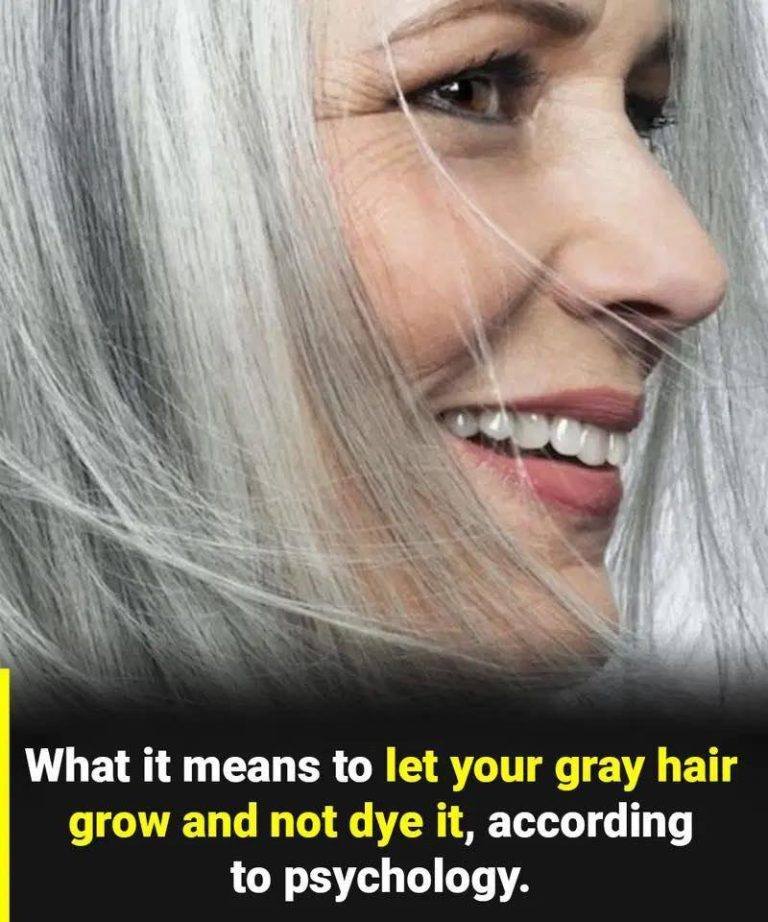
Allowing gray hair to grow naturally, without hiding it under dye, has become an intentional choice for many people. What was once almost exclusively associated with aging or decline is now being seen through a psychological lens. This shift is far from superficial—it reflects deeper changes in how individuals perceive identity, self-worth, and the pressure to meet societal expectations.
For years, gray hair carried a strong cultural message. It was linked to loss—of youth, attractiveness, relevance, and sometimes even capability. In many societies where appearance and productivity are highly valued, aging was something to be concealed. Hair dye became less a matter of style and more a strategy to maintain social acceptance. Choosing to stop dyeing is therefore far from a neutral act; it is a conscious rejection of a long-standing narrative.
Psychologically, letting gray hair show often marks a turning point in self-perception. Hair is a key part of identity: it frames the face, signals belonging, and communicates subtle cues about personality and status. Changing how one treats it—especially by removing artificial enhancement—can trigger a re-evaluation of how one wishes to be seen and how much influence others should have over that image.
Experts note that this decision frequently comes after a period of internal acceptance. Those who stop dyeing often experience discomfort first—worrying about judgment, fearing they’ll be seen as “letting go,” or anxious about becoming invisible. These concerns are real, rooted in years of conditioning. Moving past them often coincides with growing self-trust and emotional maturity.
Embracing gray hair can serve as a quiet declaration: “I no longer need to disguise myself to be acceptable.” This doesn’t mean neglecting appearance. Many who go gray become more intentional about grooming, clothing, and posture. The difference lies in motivation: the focus shifts from hiding flaws to expressing authenticity.
This choice carries particular significance for women, who historically face more scrutiny over aging. While men with gray hair are often labeled “distinguished” or “experienced,” women have been expected to maintain youthfulness to retain value socially and professionally. Choosing to let gray hair grow can thus represent resistance to a double standard and reclaim agency over one’s body and image.
Men, too, face pressures around gray hair, particularly in competitive work environments. It can be associated with fears of being overlooked or perceived as less adaptable. Choosing natural hair in such contexts signals confidence and a refusal to define worth by constant performance. In both cases, the decision reflects a recalibration of internal versus external validation.
Another psychological layer involves time. Dyeing gray hair can feel like a struggle against aging—an ongoing effort to delay an inevitable change. Letting it grow naturally often comes with a shift in perspective: aging is no longer an adversary, but a part of identity to be integrated. This doesn’t romanticize aging or ignore its challenges, but it removes the need to define oneself in opposition to it.
Many report a profound sense of relief once they embrace gray hair. Beyond the practical ease of no longer maintaining dye, there is emotional relief: less vigilance, less self-monitoring, less fear of judgment. Psychologically, this reduces stress and frees mental energy for other priorities. The self ceases to feel like a project requiring constant management.